Oatmeal Lace Cookies with Crisp, Buttery Edges
Oatmeal lace cookies bake into delicate golden discs with tiny holes, crisp edges and a buttery brown sugar flavor. A small spoonful spreads surprisingly far, so the secret is giving each cookie room and letting it firm up before lifting it. These are lovely beside coffee, scattered around a scoop of ice cream, or packed carefully into a holiday cookie tin.
This version uses rolled oats, a little flour and an egg-free saucepan batter. There is no mixer or frosting to organize. The cookies are thin enough to snap once cool, with oat flakes adding texture to the caramel-like base.
What makes a lace cookie different?
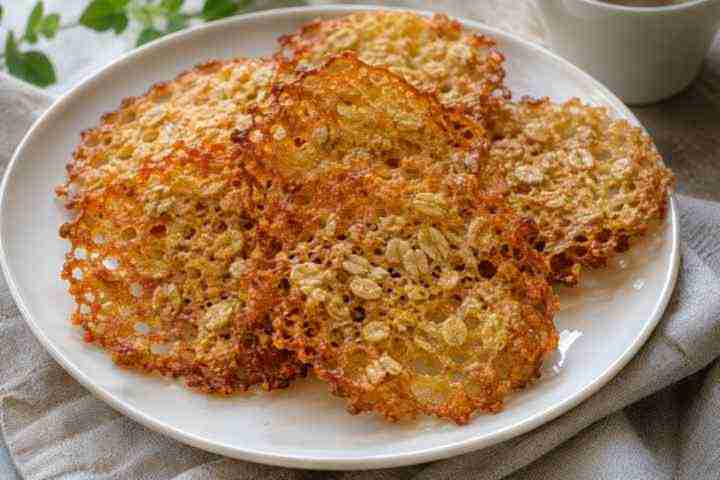
Unlike a thick oatmeal cookie, oatmeal lace cookies have relatively little flour. The butter and sugar melt together, and the small portions spread as they bake. Bubbles leave a network of holes while the oats hold the thin sheet together. Expect delicate, uneven circles rather than identical cut-out shapes.
The goal is an evenly golden center with slightly darker edges. Pale centers tend to stay sticky; very dark edges can taste bitter. A first tray gives you a useful guide to your oven, especially if your baking sheets are dark or your oven runs hot.
Ingredients and helpful notes
- 85 g unsalted butter, cut into pieces
- 100 g light brown sugar
- 15 ml whole milk
- 60 g old-fashioned rolled oats, finely chopped with a knife or briefly pulsed
- 16 g all-purpose flour
- 1 g fine salt
- 3 ml alcohol-free vanilla flavoring
Use real butter for its flavor and predictable water content. Spreadable tub butter can change how far the batter spreads. Light brown sugar provides a gentle molasses note without overwhelming the oats. Dark brown sugar can be used at the same weight, although the darker batter makes the browning harder to judge.
Chop the oats into smaller flakes without turning them into flour. Large whole flakes can leave weak spots, while finely ground oat powder absorbs more liquid and changes the texture. Quick oats are a practical alternative at the same weight; avoid instant flavored packets and steel-cut oats.
The small flour quantity still matters: it helps the cookies hold together. Measure it by weight rather than adding a heaped spoonful. No baking soda or baking powder is needed. Alcohol-free vanilla keeps the recipe alcohol-free; you can omit it if unavailable.
How to make oatmeal lace cookies
1. Heat the oven and melt the base
Heat the oven to 175°C (350°F), conventional setting, with a rack in the center. Line two large, light-colored baking sheets with baking parchment. Whisk the chopped oats, flour and salt together in a bowl. Put the butter, brown sugar and milk in a small saucepan. Stir over medium-low heat until the butter melts and the mixture begins to bubble around the edge, about 3 minutes. Remove from the heat; do not boil it into a thick caramel.

2. Stir and portion the batter
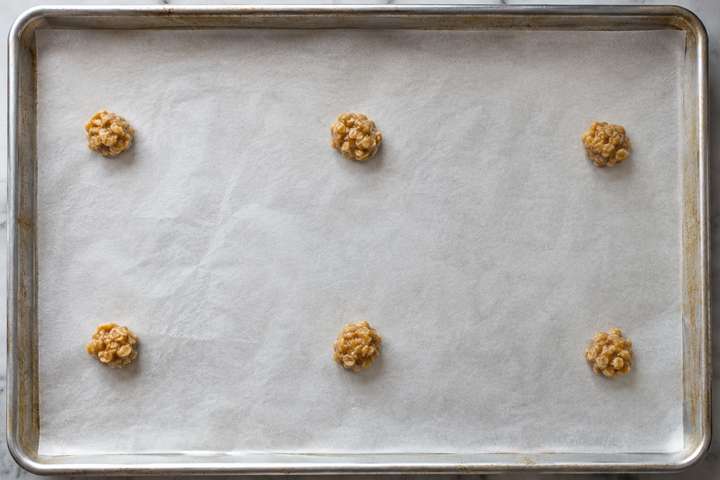
Stir the oat mixture and vanilla into the saucepan until no dry flour remains. Let the batter stand for 5 minutes so it thickens slightly. Divide into 24 small portions, roughly 11 g each, or about 2 level teaspoons. Put only six on each sheet, leaving at least 10 cm between their centers and space around the pan edges. Keep them in small mounds; there is no need to flatten them.
3. Bake until golden and lacy
Bake one sheet at a time for 7–9 minutes. Look for a bubbling, lacy surface and golden centers with amber edges. Start checking at 7 minutes. The cookies will still be soft when the sheet comes out. For the remaining portions, use a completely cool sheet and stir the batter before scooping. The recipe makes four trays of six; the card allows about 32 minutes of oven time plus the saucepan stage.
4. Let the cookies set before lifting
Leave each batch on its parchment for 5–7 minutes, until firm enough to move. Slide the parchment onto a rack if you need the pan for another batch. Use a thin spatula to lift the cookies once they release easily, then cool completely. Hot sugar can burn, so avoid touching or shaping the cookies while they are bubbling.

Do not taste the uncooked batter, even though it contains no eggs. Flour is a raw ingredient; the FDA’s flour safety guidance explains why dough and batter should be cooked before eating. Wash the utensils and work surface after handling raw flour.
Substitutions and small variations
For a warm spice note, add ¼ teaspoon ground cinnamon to the dry ingredients. For citrus aroma, stir in ½ teaspoon finely grated orange zest with the vanilla. Keep additions small: chopped nuts, dried fruit and chocolate chips can interrupt the delicate structure and make these harder to portion.
If you want chocolate, drizzle up to 40 g melted dark chocolate over the fully cooled cookies and let it set before storing. That topping is optional and is excluded from the nutrition estimate. Check the chocolate label if avoiding alcohol or particular allergens. Milk can be replaced with the same amount of water, though the flavor will be slightly less rounded. A dairy-free butter substitution may change the spread, so start with a single small test cookie.
Troubleshooting the spread and texture
The cookies joined together: reduce the number on the next tray or make the portions slightly smaller. While a joined batch is still warm, you can separate it gently with a thin spatula, but let it firm before moving the pieces. Irregular edges are part of their charm.
The centers are chewy or sticky: check that the portions are small and the centers reached a golden color. Bake the next tray a little longer, watching closely. Humid weather also softens cooled cookies. Keep them sealed once completely cool.
The edges burned before the centers colored: use a light-colored pan, check your oven temperature and move the tray away from the lower element. A dark sheet can brown the base quickly. Do not put fresh batter onto a warm pan.
The cookies broke when lifted: they likely needed more cooling time. Leave the next batch on the parchment until it releases without stretching. Broken pieces still make a good crunchy topping for yogurt or ice cream.
Serving and storing
Serve oatmeal lace cookies in a shallow dish rather than piling them high. For a cookie box, place them in a rigid compartment with parchment between layers, separate from moist cookies, fruit or frosting. They are fragile, so they suit hand-delivered gifts better than a loosely packed parcel.
Store completely cooled plain cookies in an airtight container at cool room temperature for up to 4 days for best texture. For longer storage, freeze in a rigid airtight container with parchment between layers for up to 1 month. Thaw in the closed container to reduce condensation on the cookies.
Reheating is usually unnecessary. To refresh plain cookies that have softened, place them on parchment in a 150°C (300°F) oven for 2–3 minutes, then cool fully before judging the texture. Watch closely and do not refresh chocolate-drizzled cookies this way.
Frequently asked questions
Can I make the batter ahead?
This batter is easiest to portion shortly after mixing. If it firms as you bake, stir it gently and use the same portion weight. Avoid adding extra milk simply to loosen it, because more liquid can change the spread.
Are lace cookies gluten-free?
This recipe contains wheat flour and is not gluten-free. Oats alone do not make a cookie gluten-free. For a medically necessary gluten-free diet, use a recipe developed for that purpose with suitable certified ingredients.
Can I double the recipe?
Yes, but allow enough time and cool pans for the extra trays. Keep the individual portion size and spacing the same. Making two separate batches can be easier than keeping one large saucepan of batter at a consistent texture.
Why do the cookies look soft straight from the oven?
The hot butter and sugar are still fluid. Cooling lets the thin cookies set. Judge crispness only after they have cooled completely, and use color and bubbling as the baking cues.
A crisp addition to your holiday cookie tray
Small portions, generous spacing and patient cooling make oatmeal lace cookies a useful contrast to richer holiday desserts. Keep a tin of these thin, buttery oatmeal cookies ready for coffee, or add a few to a Christmas cookie box with sturdier bakes.
For more holiday baking, try butter spritz cookies, almond Linzer cookies with raspberry jam, soft molasses cookies or butter pecan cookies.
Follow us on Pinterest · Follow us on Instagram
Oatmeal Lace Cookies
Ingredients
Method
- Heat the oven to 175°C (350°F), conventional setting, with a rack in the center. Line two large light-colored baking sheets with baking parchment. Mix the chopped oats, flour and salt in a bowl. Stir the butter, brown sugar and milk over medium-low heat until melted and bubbling at the edge, about 3 minutes. Remove from the heat; do not boil into a thick caramel.

- Stir the oat mixture and vanilla into the saucepan until no dry flour remains. Let stand 5 minutes. Divide into 24 portions, roughly 11 g or about 2 level teaspoons each. Put six mounds on a sheet, at least 10 cm apart, leaving space at the edges. Do not flatten.
- Bake one sheet at a time for 7–9 minutes, checking from 7 minutes, until the centers are golden and lacy and the edges amber. Cookies will still be soft. Stir the remaining batter before scooping and use completely cool pans. Makes four trays of six; allow approximately 32 minutes of oven time plus 3 minutes for the saucepan stage.
- Leave each batch on the parchment for 5–7 minutes until it releases easily. Slide the parchment onto a rack if the sheet is needed again. Lift with a thin spatula and cool completely. Do not touch the bubbling hot sugar. Store airtight once fully cool.



Notes
Get easy recipes in your inbox
Join TasteWiser for new recipes, cooking tips and fresh inspiration.
Confirm your email to subscribe. Unsubscribe anytime.