Easy Stuffing Recipe with Bread, Celery and Herbs
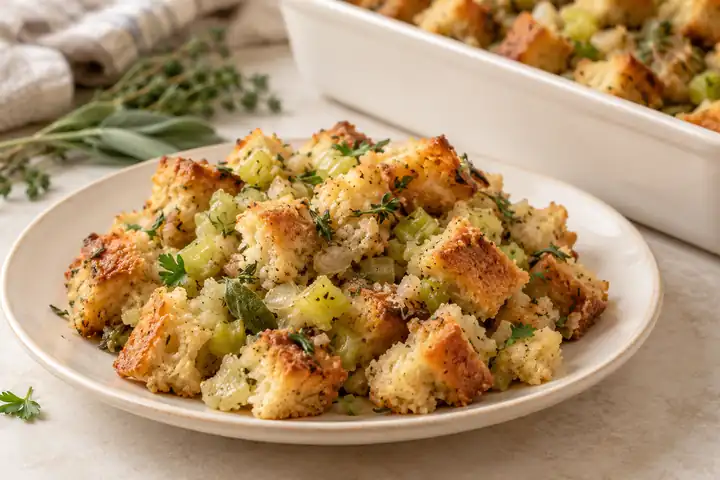
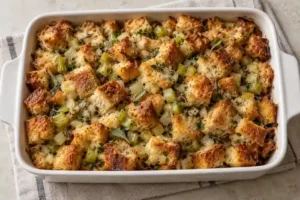
This easy stuffing recipe combines golden bread cubes, buttery onion, celery and fragrant herbs in one baking dish. The middle stays soft and savory while the uncovered top develops crisp, toasted edges. It is a simple side for a holiday table or a family roast dinner.
The method starts with drying the bread rather than relying on a loaf that happens to be stale. You then add broth gradually, so you can stop when the cubes are moist but still hold their shape. Sage, thyme and parsley provide the classic flavor without needing a packet of seasoning.
Why this stuffing recipe works
- Texture you can control: dried bread takes up broth without immediately collapsing.
- Simple ingredients: bread, vegetables, butter and herbs form the base.
- Golden top: a covered bake warms the middle, then an uncovered finish crisps the surface.
- A separate baking dish: the stuffing cooks evenly and can go straight to the table.
Ingredients for homemade bread stuffing
This stuffing recipe makes ten side-dish portions in a 9-by-13-inch baking dish. The printable card at the end contains the complete quantities.
- 600 g rustic white bread: weigh it before drying, then cut into roughly ¾-inch / 2 cm cubes. Choose a loaf with a fairly even crumb rather than very large holes.
- 113 g unsalted butter: eight tablespoons, with a little additional butter for the dish.
- 250 g yellow onion and 200 g celery: dice the onion and chop the celery small enough to distribute throughout the bread.
- Three garlic cloves: minced, for a gentle savory background.
- Fresh herbs: two tablespoons chopped sage, one tablespoon thyme leaves and three tablespoons chopped parsley.
- 600 ml low-sodium vegetable broth: start with 480 ml and add the rest as needed. Keep up to 120 ml extra available for especially dry bread.
- Two large eggs: help the bread mixture hold together while leaving the cubes recognizable.
- ½ teaspoon fine salt and ½ teaspoon black pepper: reduce the salt if your bread or broth is particularly salty.
Low-sodium chicken broth also works if it suits your menu. To keep this a vegetarian stuffing recipe, use vegetable broth and check the bread ingredients. The standard version contains wheat, milk and eggs.
The best bread for this stuffing recipe
A sturdy white country loaf or mild sourdough works well. Leave the crusts on for extra texture, unless the crust is unusually hard or thick. Soft sandwich bread can be used, but handle it gently and begin with less broth because it can become pasty quickly.
Use the bread’s weight as the main guide. Cup measurements vary depending on how large the cubes are and how tightly they are packed. The 600 g loaf will usually give a generous bowl of cubes; do not squeeze them down to force an exact cup count.
For more on choosing a loaf, King Arthur Baking’s bread guidance explains how crumb structure affects stuffing texture.
How to make this easy stuffing recipe
1. Dry the bread cubes
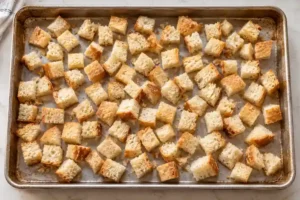
Heat a conventional oven to 250°F / 120°C. Spread the bread cubes over two rimmed baking sheets in a loose, even layer. Bake for 40–60 minutes, turning once or twice, until dry through the middle with little browning. Break open a larger cube to check it; the center should not feel soft and fresh.
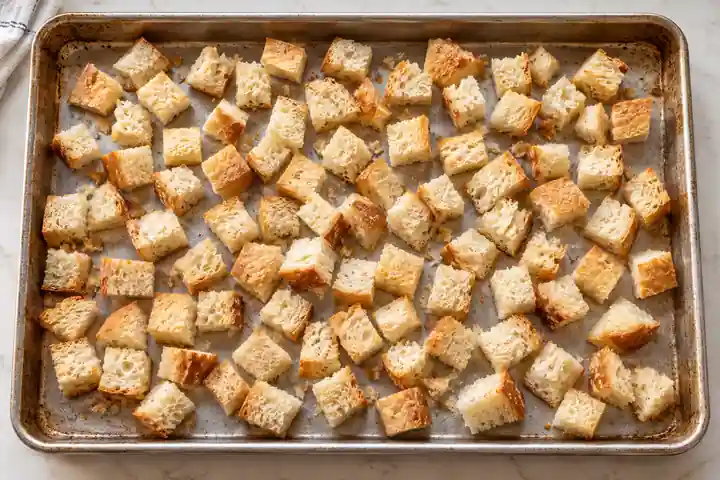
Remove the trays and let the bread cool slightly. Increase the oven to 350°F / 175°C and butter a 9-by-13-inch baking dish. If your bread was already thoroughly dried, skip the drying stage and start with the lower amount of broth.
2. Soften the onion and celery
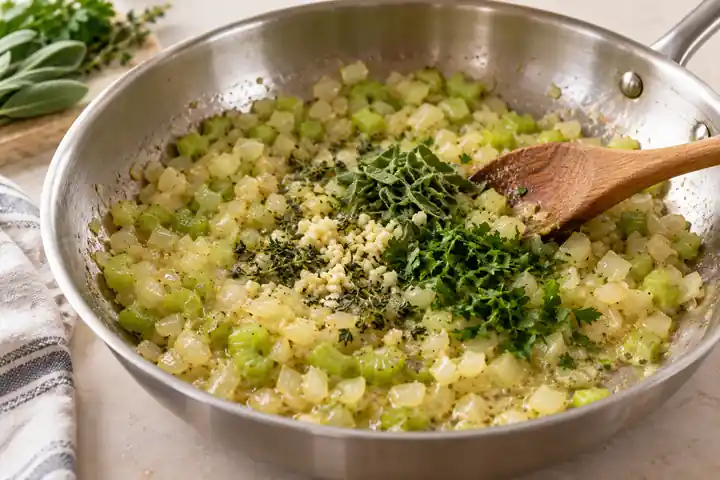
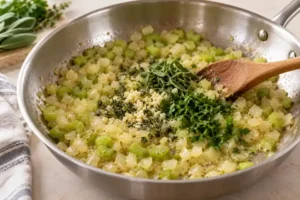
While the bread dries, melt the butter in a large skillet over medium heat. Add onion and celery and cook for 10–12 minutes, stirring, until softened. Lower the heat if the butter or onion starts to brown heavily.
Stir in garlic, sage and thyme for another minute. Remove the skillet from the heat, add parsley and let the mixture cool until warm rather than hot. Softening the vegetables first prevents crunchy raw celery from interrupting the finished texture.
3. Moisten the bread gradually
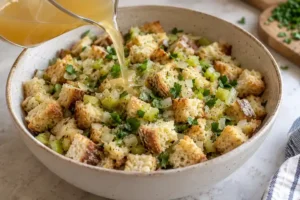
Place the dried bread in a very large mixing bowl. Add the warm vegetable mixture, salt and pepper, and toss gently. In a separate bowl, whisk the eggs with 480 ml of cool or room-temperature broth. Pour this over the bread while folding with a broad spoon.
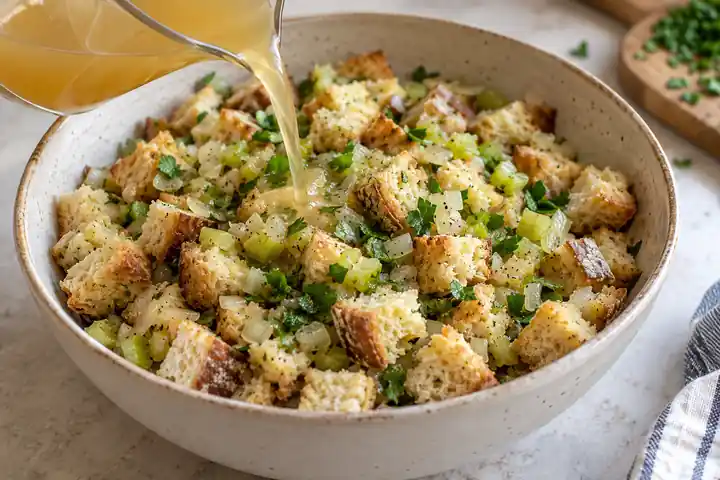
Let the bread absorb the liquid for about five minutes. Add the remaining 120 ml broth a little at a time if dry centers remain. For very absorbent bread, use some of the extra broth. The cubes should feel evenly damp and give slightly when pressed, with no pool of liquid underneath. Do not taste the mixture after adding raw eggs.
4. Bake covered, then uncover
Transfer the mixture to the buttered dish without packing it down. Cover with foil and bake for 30 minutes. Remove the foil and bake for 20–30 minutes more, until the top is golden and the center reaches 165°F / 74°C on a food thermometer.
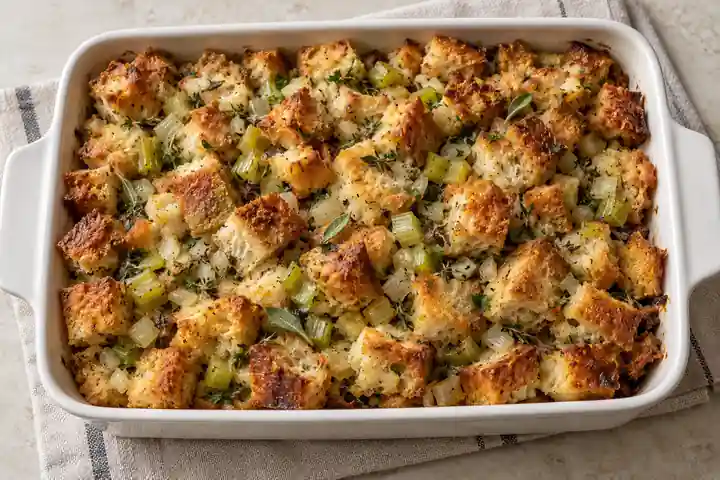
If the surface browns before the center is hot enough, loosely cover it again and keep baking. Rest for ten minutes before serving. This stuffing recipe is designed for a separate casserole dish; its timing is not intended for cooking inside poultry.
Stuffing recipe tips for the right texture
If the mixture looks dry before baking: fold in small additions of broth, waiting briefly between additions. A few dry-looking edges are fine, but the insides of the cubes should be damp.
If the mixture looks wet: stop adding broth. Fold in a handful of extra dried bread if needed. Avoid pressing the mixture into a compact layer, which makes the middle feel heavier.
If the cooked stuffing is dry: drizzle a little hot broth over the dry area, cover and warm briefly. Add liquid carefully so the crisp surface does not become completely soft.
If you want more crisp edges: spread the bread loosely and use the full-sized dish. A smaller, deeper pan gives a softer middle and can take longer to heat through.
Herb substitutions and variations
For dried herbs, use two teaspoons dried sage and one teaspoon dried thyme in place of the fresh sage and thyme. Keep the fresh parsley if available. Rub dried herbs between your fingers before adding them to the skillet.
For mushroom stuffing, cook 200 g sliced mushrooms separately until their released liquid has evaporated, then fold them in with the vegetables. Extra wet mushrooms change how much broth the bread needs, so keep using the moisture check.
For gluten-free stuffing, choose a sturdy gluten-free loaf and certified gluten-free broth. Dry the cubes and add liquid gradually; different gluten-free breads can soften quite differently. Nutrition changes with substitutions.
What to serve with this stuffing recipe
This stuffing recipe goes well with roast chicken, turkey or a vegetable main dish. Build a side-dish spread with green bean casserole from scratch, cranberry sauce with orange and sweet potato casserole with pecans.
For dessert, add pumpkin pie with evaporated milk. Choose a few sides with contrasting textures so the meal includes something fresh or crisp alongside the bread.
Nutrition and calories
Calories per serving: about 270 kcal. One portion is one-tenth of the full baking dish. Gravy and other sides are not included.
| Nutrient | Per serving |
|---|---|
| Calories | 270 kcal |
| Protein | 8 g |
| Carbohydrates | 33 g |
| Fat | 12 g |
| Saturated fat | 6 g |
| Fiber | 2 g |
| Sugars | 4 g |
| Sodium | 530 mg |
Nutrition is an ingredient-based estimate using 600 g white bread, 113 g butter and 600 ml low-sodium vegetable broth. Bread and broth labels affect sodium especially; extra butter for the dish and optional variations can change the figures.
Make-ahead and storage guidance
To get ahead, dry the bread and keep it airtight once completely cool. Cook the onion-celery mixture separately, refrigerate it promptly in a shallow container and use the next day. Keep the bread and wet ingredients separate until you are ready to mix and bake; do not refrigerate a fully assembled raw stuffing overnight.
Refrigerate cooked leftovers in shallow containers within two hours, or within one hour if the room is hotter than 90°F / 32°C. Keep at 40°F / 4°C or below and use within 3–4 days. Freeze cooked portions for up to one month for good quality and thaw in the refrigerator.
To reheat, add a small splash of broth, cover and heat in a 350°F / 175°C oven until the center reaches 165°F / 74°C. Uncover briefly if you want the top crisp again. These handling points follow USDA guidance for stuffing.
Frequently asked questions
Is stuffing the same as dressing?
The names often depend on region and family tradition. “Dressing” commonly describes bread mixture baked separately, while “stuffing” can refer to the mixture cooked inside a bird. This stuffing recipe uses the separate baking-dish method.
Do I have to use eggs?
Eggs help the mixture hold together. Leaving them out gives a looser texture and changes how the liquid behaves. For the result described here, keep the eggs and follow the moisture check before baking.
Can I use boxed stuffing cubes?
Plain, unseasoned cubes can work, but 600 g fully dried cubes is not equivalent to 600 g fresh bread before drying. Follow the package’s liquid guidance as a starting point and adjust the seasonings if it is already salted.
How do I know when the stuffing is ready?
Check both appearance and temperature. The top should be golden, with no loose liquid visible, and the center must reach 165°F / 74°C. Surface color alone cannot tell you whether the middle is hot enough.
A classic herb stuffing recipe for family dinners
Keep this easy stuffing recipe for the meals when you want a comforting bread side with plenty of savory flavor. Dry the cubes, soften the vegetables and add broth gradually. Those steps help homemade bread stuffing with celery and herbs come out moist inside with a golden, crisp top.
For more recipes, Follow us on Pinterest and Follow us on Instagram.

Easy Stuffing with Bread, Celery and Herbs
Ingredients
Equipment
Method
- Heat a conventional oven to 250°F / 120°C. Spread bread cubes on two rimmed trays and dry for 40–60 minutes, turning occasionally, until dry through the middle with little browning. Cool slightly. Increase oven to 350°F / 175°C and butter a 9-by-13-inch baking dish. Skip drying only if bread is already thoroughly dried.

- While bread dries, melt butter in a large skillet over medium heat. Cook onion and celery for 10–12 minutes, stirring, until soft. Add garlic, sage and thyme and stir for 1 minute. Remove from heat, stir in parsley and cool until warm, not hot.
- Put dried bread in a very large bowl. Toss with vegetables, salt and pepper. Whisk eggs with 480 ml cool or room-temperature broth and fold into bread. Stand about 5 minutes, then add remaining 120 ml broth gradually if needed. Use up to 120 ml extra for very dry bread. Cubes should be damp but intact, without pooled liquid. Do not taste after adding raw eggs; mix only when ready to bake.
- Spoon loosely into the prepared dish; do not compress. Cover with foil and bake immediately at 350°F / 175°C for 30 minutes.
- Remove foil and bake 20–30 minutes more until golden and the center reaches 165°F / 74°C. If top browns too quickly, loosely cover again while the center finishes heating. This method is for a separate casserole dish.
- Rest for 10 minutes, then divide into 10 side-dish portions. Refrigerate leftovers promptly in shallow containers.
Notes
Get easy recipes in your inbox
Join TasteWiser for new recipes, cooking tips and fresh inspiration.
Confirm your email to subscribe. Unsubscribe anytime.